End-to-end engineering of a connected cold-chain control platform — custom hardware, ESP32 firmware, cellular connectivity, and real-time cloud visibility for refrigeration units in moving vehicles.
Three stages of development — each video shows the system running on real hardware, not a simulation.
Production-ready unit with full cellular cloud connectivity, live temperature telemetry, and remote compressor control.
Initial ESP32 board bring-up with monochrome display — validating sensor reads and UI loop.
First integrated build — compressor relay, cellular modem, and cloud sync running together for the first time.
Mobile refrigeration systems carry critical payloads — food, pharmaceuticals, temperature-sensitive materials — inside moving vehicles operating in dynamic environments. The client's existing units functioned in complete isolation: no visibility, no control, no way to detect or respond to failures remotely.
Every adjustment required manual intervention. Every failure went unnoticed until damage was done. They needed a system that stays connected 24/7, provides full remote control, and ensures operational reliability across every deployed unit — at any scale.
No real-time temperature visibility — spoilage went undetected until delivery.
Every adjustment required a technician on-site. No remote control existed.
No centralized system to manage multiple units across distributed fleets.
Moving vehicles, variable external temperatures, and intermittent cellular coverage.
Dedicated hardware card engineered for mobile refrigeration units. Manages firing cycles, captures temperature data, and executes control logic in real time — built for reliability in variable vehicle conditions.
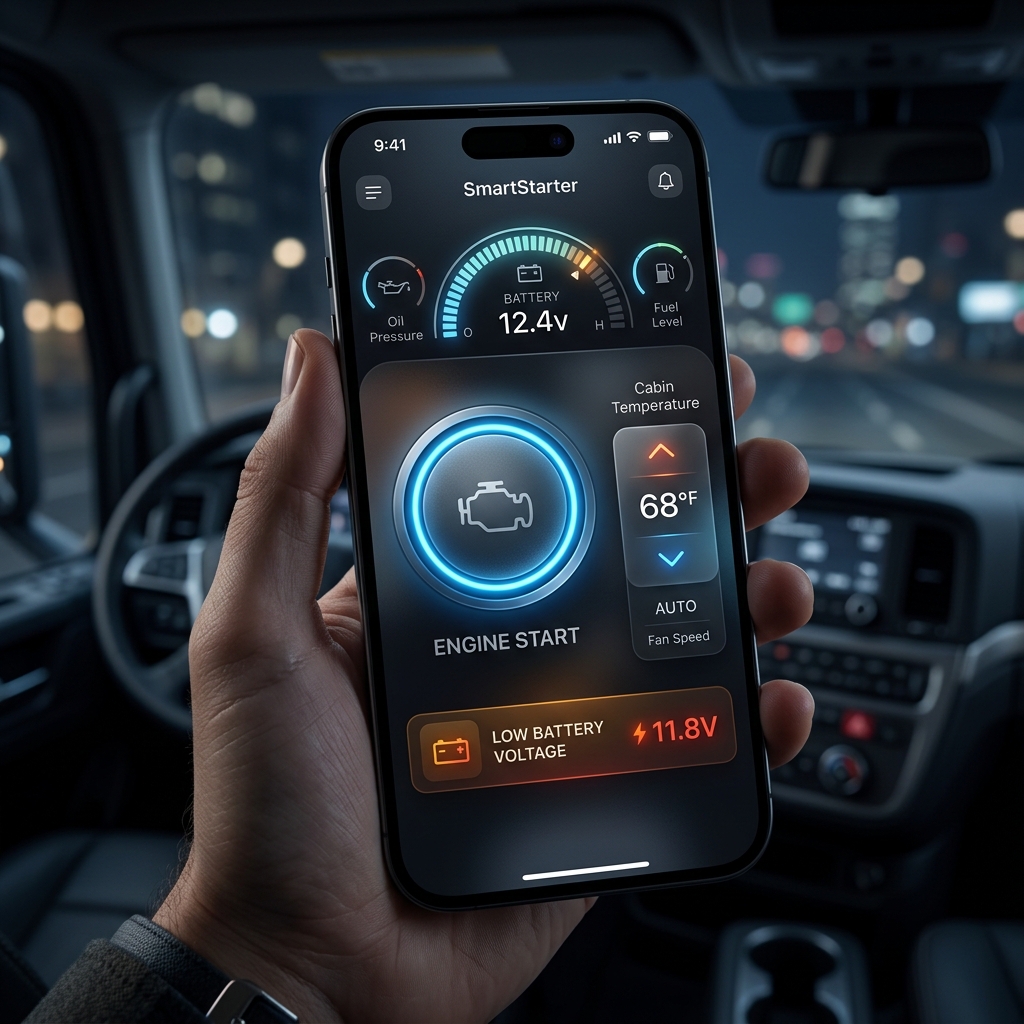
Embedded firmware on ESP32, optimized for connected IoT environments. Handles continuous temperature monitoring, intelligent cycle control, wireless communication, and automation logic under real-world operating conditions.
Persistent 24/7 connectivity via integrated Quectel communication module. Enables real-time data transmission, remote command execution, and reliable performance in moving vehicle environments — connectivity as a core layer, not an afterthought.
Full-stack platform with real-time monitoring, remote temperature control, automated alerts, live location tracking, and multi-unit fleet management — accessible via mobile app and web dashboard.
Set and adjust temperature from anywhere via mobile app or web dashboard — no technician required on-site.
Continuous temperature telemetry streamed to cloud. Live dashboard shows current state of every deployed unit.
Instant notifications when temperature deviates from defined thresholds — before spoilage occurs.
GPS tracking integrated into the platform. Know where every unit is at all times across the fleet.
Centralized dashboard to monitor, control, and manage multiple refrigeration units simultaneously.
Persistent cellular connection via Quectel ensures continuous data flow even in remote or moving environments.
Every constraint in this project came from the physical world — moving vehicles, dynamic temperatures, remote locations, and payloads that can't afford failure. We solved each at the engineering layer.
Vehicle vibration, power fluctuations, and external temperature swings required hardware and firmware engineered specifically for mobile deployment — not adapted from stationary designs.
Maintaining 24/7 connectivity in moving vehicles with variable signal strength required a communication layer that handles intermittent coverage gracefully — queuing data, confirming delivery, alerting on failures.
Firmware, cloud, and applications had to stay synchronized in real time. Any lag between a temperature event and an operator alert could mean spoilage. The pipeline was engineered for minimal latency end-to-end.
The platform had to manage a single unit on day one and scale to an entire fleet without re-engineering. The cloud backend was designed for horizontal scale from the start.
We owned the full stack — from control hardware and embedded firmware to cellular communication, cloud backend, and user-facing applications. No external dependencies on any critical layer.
We engineer complete systems — control hardware, embedded firmware, cellular connectivity, cloud platforms, and mobile apps — all under one roof.