Current
Detection
Sensor System
Smart non-invasive current monitoring for industrial welding machines — real-time data capture, wireless transmission, and offline storage without modifying machine wiring.
Non-invasive sensor → acquisition hardware → cloud server
Machine
Sensor
Hardware
Server
Smart Current Monitoring for Welding Machines
At Inurum Technologies, we developed a smart current detection sensor system for industrial welding machines. The system monitors welding current in real time without modifying existing machine wiring.
The client needed a reliable system to detect and record current flow during welding operations. Traditional manual inspection was insufficient to verify every welding pulse, and there was no centralized way to collect current data from machines across the factory floor.
We designed a non-invasive solution using a split-core Hall Effect sensor installed around the welding output cable. The sensor captures current data during every welding cycle — the hardware processes it and transmits wirelessly to the server for monitoring, reporting, and analysis.
No Visibility Into Welding Performance
Industrial welding machines require accurate current monitoring to ensure consistent weld quality. Without real-time data, quality issues go undetected until inspection — by which point rework costs are already high.
-
ISSUE_01
No real-time current visibility during welding operations
-
ISSUE_02
No automated welding data logging — all records were manual
-
ISSUE_03
Manual dependency for quality checks created bottlenecks
-
ISSUE_04
No easy way to track welding pulse performance over time
-
ISSUE_05
Risk of inconsistent welding output across production shifts
-
ISSUE_06
No remote monitoring — engineers had to be physically present
-
ISSUE_07
Existing machine wiring could not be modified for safety reasons
Non-Invasive. Wireless. Always On.
We built a current detection sensor system that installs without cutting or changing machine wiring. The split-core Hall Effect sensor clamps around the welding output cable and detects current inductively — no electrical contact required.
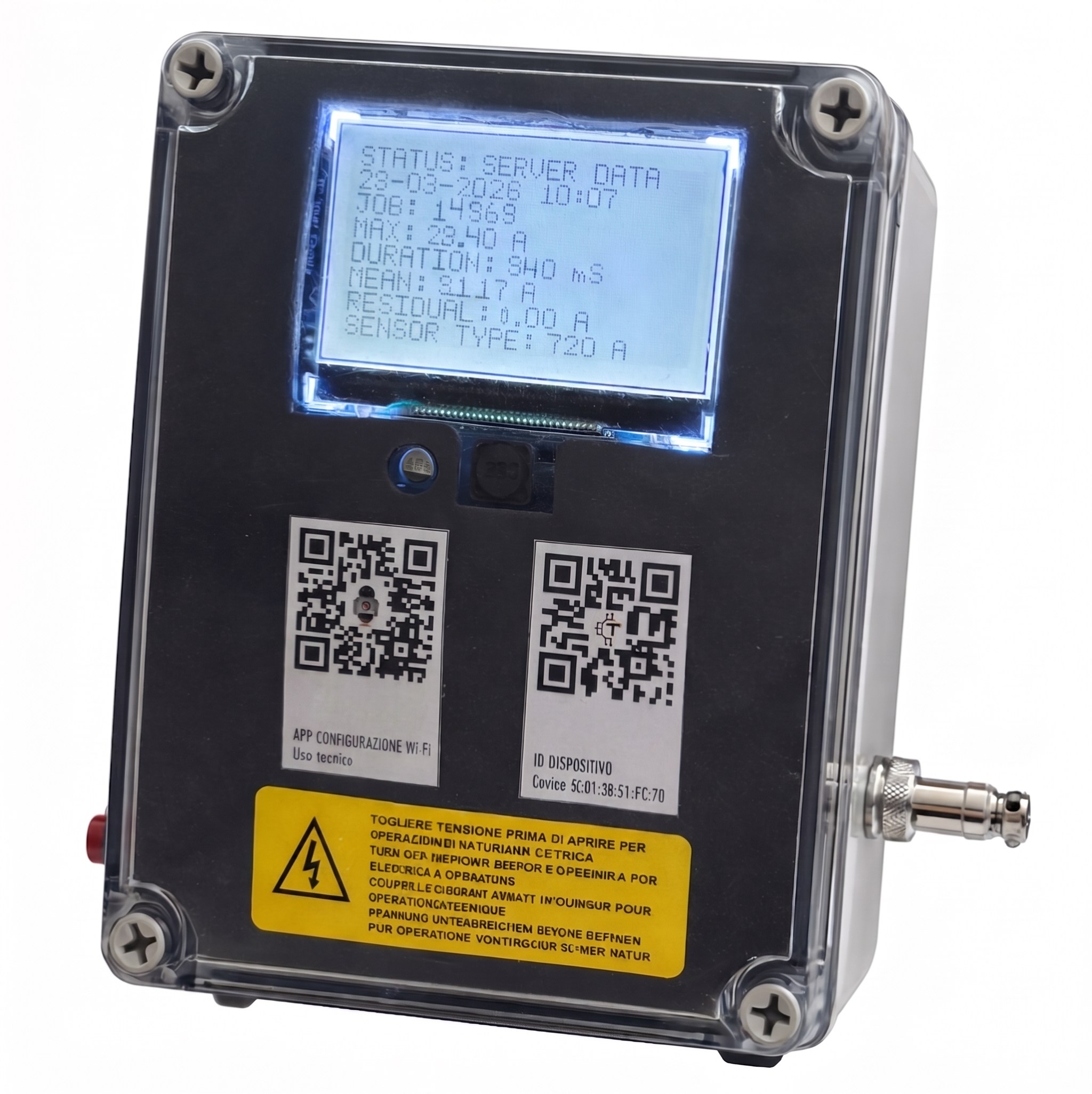
The acquisition hardware captures the sensor signal and calculates key parameters for every welding pulse: peak current, average current, pulse duration, residual current, and current variation.
All data is transmitted to the server using Wi-Fi in JSON format via HTTP POST. If connectivity is unavailable, data is stored locally and automatically uploaded when the connection is restored.
What the System Delivers
Core capabilities of the IoT current detection sensor — from non-invasive installation to real-time cloud data transmission.
From Cable to Cloud
7 automated steps — no operator input required during production.
See It
In Action
The sensor unit running live on a welding machine — capturing current data, logging each pulse, and transmitting to the server in real time.
What's Inside the System
The system is built around proven industrial components — shielded sensor cabling, a Wi-Fi-enabled controller, and an internal power supply designed for continuous factory operation.
What Manufacturers Gain
Where This System Fits
Designed for industrial welding, the underlying architecture applies to any current-monitoring use case in factory IoT environments.
-
USE_CASE
Welding machine monitoring and quality assurance
-
USE_CASE
Industrial automation and smart factory IoT systems
-
USE_CASE
Production line monitoring and output tracking
-
USE_CASE
Quality control and weld traceability systems
-
USE_CASE
Current logging for predictive maintenance
Result
The current detection sensor system gave the client a reliable way to monitor welding current in real time. With non-invasive installation, wireless data transfer, and offline storage support, the solution improved visibility, traceability, and quality control for industrial welding operations.
Deployable to any machine without modifying existing infrastructure — the system scales from a single unit to an entire production floor with no additional wiring or downtime.
Related Work & Services
Need a Custom IoT
Monitoring Solution?
Inurum Technologies builds custom IoT, embedded, firmware, mobile app, and cloud-based monitoring solutions for industrial use cases. Let's build your next smart connected product.